

Fixed package
Student Coaching and Reasoning Games
One purchase, a connected learning pathway.
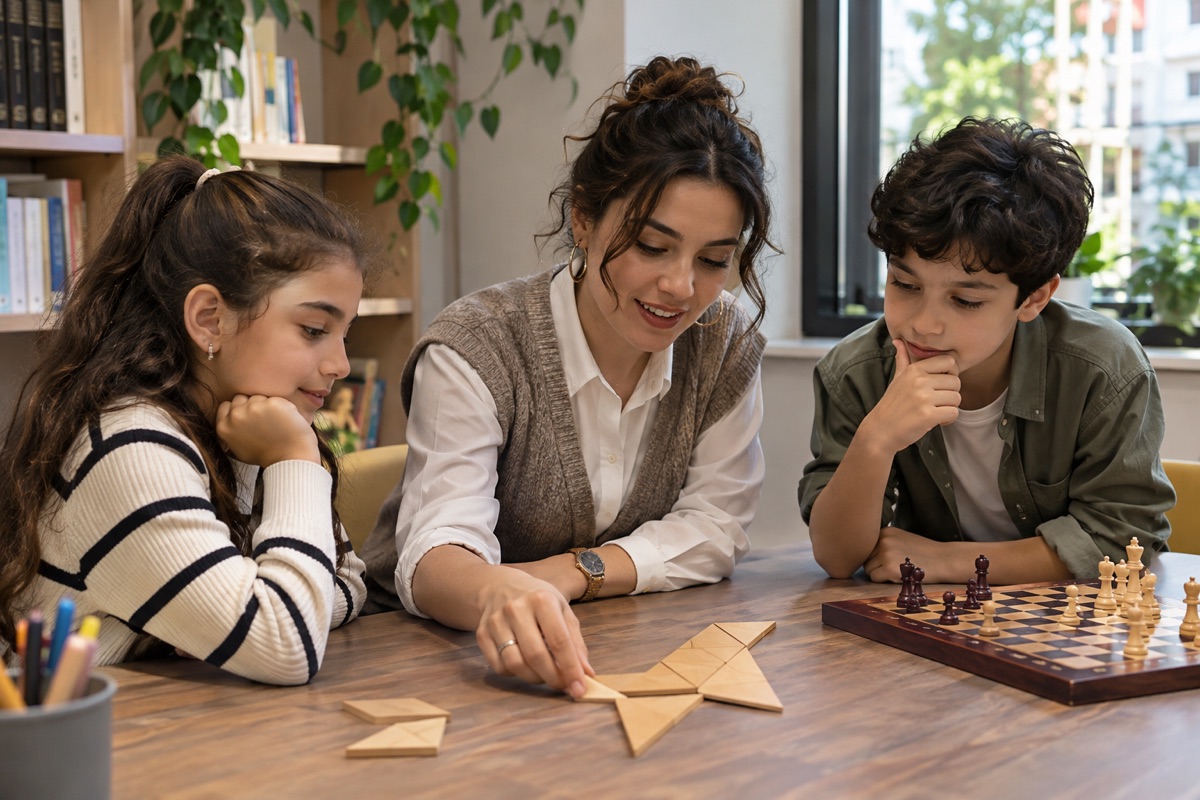
Student Coaching and Reasoning Games brings together three complementary courses, each with eight modules. The curriculum combines subject knowledge, responsible role boundaries and practical work.
Who can attend?
People wishing to work with students, educational support workers, parents, children's workshop organisers and anyone interested in learning processes. Open to everyone; no particular profession or diploma is specified for participation. Employment and practice authority depend on legislation and employer requirements.
Curriculum
Student Coaching
1. Coaching framework and boundaries
Distinguishing coaching from teaching, psychological counselling and therapy; ethics, confidentiality and collaboration with parents. Practice: write a service scope and meeting principles.
2. Initial meetings and needs analysis
Identifying students' strengths and priorities through open questions. Practice: prepare an introductory student-interview form.
3. Setting goals
Developing achievable and observable academic, behavioural and personal goals. Practice: design a four-week goal card.
4. Time and study planning
Flexible study schedules that balance lessons, rest, sleep and free time. Practice: create a weekly study and time-management timetable.
5. Learning strategies
Planning review, retrieval practice, active learning and managing distractions. Practice: prepare a learning-strategy trial plan.
6. Motivation and self-regulation
Monitoring progress, making small achievements visible and supporting children's own decisions. Practice: develop a self-assessment and motivation tracker.
7. Communication with families and schools
Balancing family expectations with student needs and defining referral and information-sharing boundaries. Practice: write a parent-briefing outline.
8. Monitoring and evaluating progress
Reviewing goal data and sustainable habits, and referring to a specialist when needed. Practice: prepare a four-week progress-report template.
Reasoning Games
1. Purposes and boundaries of reasoning games
Features of strategy, logic, visual-perception and memory games; distinguishing them from intelligence measurement. Practice: create a game-classification chart.
2. Choosing age-appropriate games
Considering age, instruction complexity, material safety and accessibility. Practice: write game-selection cards for different age groups.
3. Attention and planning games
Following sequences, understanding rules, thinking ahead and managing attention. Practice: plan an attention-focused game session.
4. Logic and problem solving
Patterns, matching, sequencing, probability and testing hypotheses. Practice: prepare a progressively more challenging problem set.
5. Visual and spatial skills
Shape construction, assembling parts into wholes, and position and direction games. Practice: develop a spatial task using physical materials.
6. Cooperation and fair play
Turn-taking, winning and losing, conflict management and constructive game language. Practice: design a group-game observation form.
7. Adaptation and inclusion
Adapting time, rules and materials for different abilities without overemphasising competition. Practice: write introductory and advanced versions of a game.
8. Evaluating games
Participation, testing strategies, explaining ideas and reflecting after play. Practice: prepare an activity-evaluation rubric.
Reasoning Games Facilitation
1. The facilitator's role and planning
Learning objectives, time, group size and safe material management for different ages. Practice: prepare a 60-minute workshop plan.
2. Steps for teaching a game
Short explanations, demonstration rounds, supported trials and independent play. Practice: write a sample game-instruction guide.
3. Facilitating groups
Paired play, small-group rotations, equal participation and resolving disagreements. Practice: design a rotating-station plan.
4. Matching games to learning objectives
Connecting game mechanics with attention, planning, reasoning and language objectives. Practice: prepare a game-and-learning-outcome matching chart.
5. Differentiation and accessibility
Visual instructions, adjusted timing, low-cost materials and participation adaptations. Practice: develop game plans for three participation levels.
6. Activity assessment and feedback
Process-focused rubrics, peer feedback and post-game reflection questions. Practice: prepare observation and feedback forms.
7. Organising workshops and tournaments
Balancing competition, safe event flow, registration, equipment and communication with families and institutions. Practice: create an event-organisation checklist.
8. Facilitator portfolios
Sample lesson plans, material photographs, ethical permissions and job-application presentations. Practice: prepare a portfolio containing three lesson plans.
Integrated practical portfolio
Prepare a four-week student-goal plan, an age-appropriate six-game workshop programme, a learning rubric and a draft parent briefing.
Suggested learning and assessment
Understand the concepts, child safety and age-appropriate ethical boundaries; produce module assignments, observation forms and sample activity plans; then integrate the three courses in one portfolio with self-review and feedback.
Student-goal plan 30%, game-activity design 35%, workshop and monitoring portfolio 35%.
Professional boundaries and certificate scope
Coaching does not replace psychological counselling, psychotherapy or official teaching qualifications. Reasoning-game activities are not intelligence tests, diagnosis or measurements of intelligence.
Frequently asked questions
Which courses are included?
Student Coaching · Reasoning Games · Reasoning Games Facilitation
Who can attend?
People wishing to work with students, educational support workers, parents, children's workshop organisers and anyone interested in learning processes. Open to everyone; no particular profession or diploma is specified for participation. Employment and practice authority depend on legislation and employer requirements.
Does this package confer professional practice authority?
Coaching does not replace psychological counselling, psychotherapy or official teaching qualifications. Reasoning-game activities are not intelligence tests, diagnosis or measurements of intelligence.