

Fixed package
Dental Clinic Assistance and Infection Prevention
One purchase, a connected learning pathway.
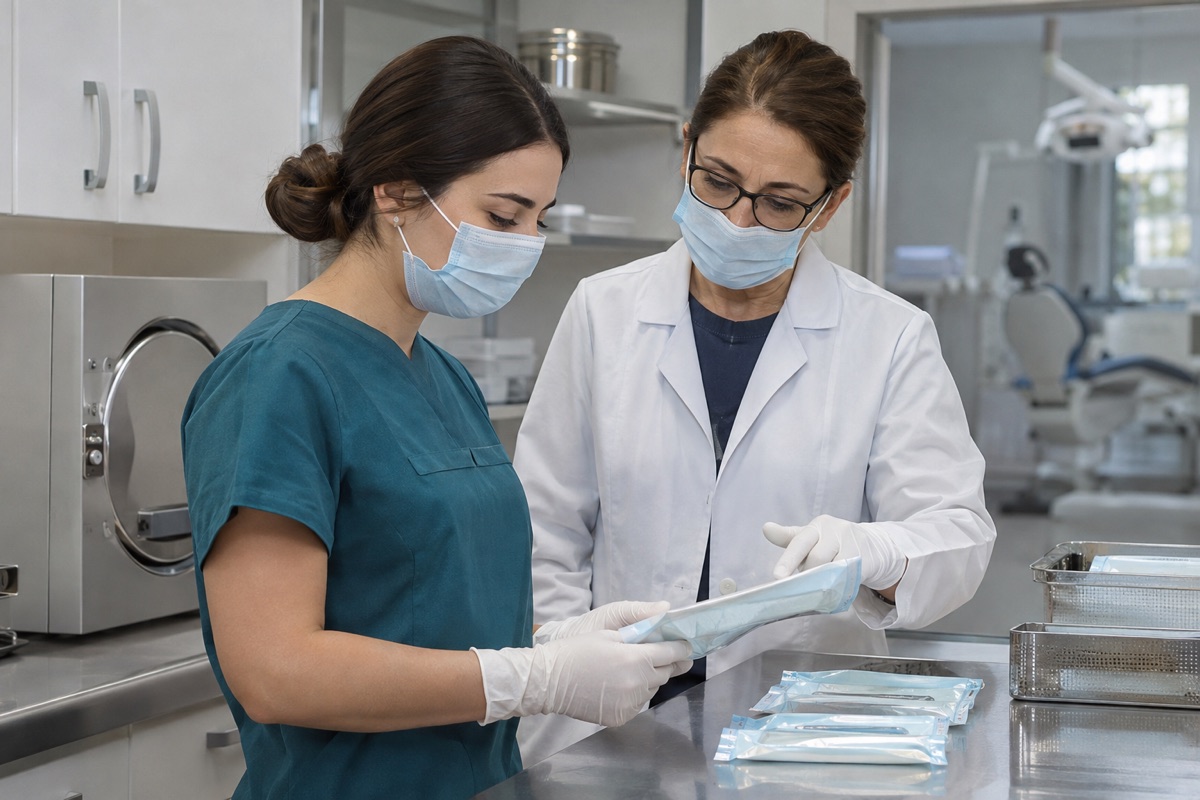
Dental Clinic Assistance and Infection Prevention brings together three complementary courses, each with eight modules. The curriculum combines subject knowledge, responsible role boundaries and practical work.
Who can attend?
Open to everyone, including people considering administrative or logistical support in dental clinics, healthcare career changers, existing clinic support staff and people wishing to study hygiene systematically.
Curriculum
Dental Assistance
1. Dental clinic workflows and team roles
Dentists' clinical responsibilities, assistant support tasks, treatment-role boundaries and patient flow. Practice: prepare the clinic's opening and closing task schedule.
2. Basic oral and dental terminology
Introduction to tooth and jaw anatomy, recognising common treatment names, material terminology and accurate communication. Practice: create terminology cards and a patient-referral glossary.
3. Appointments and patient reception
Logistical support for medical-history forms, preparation, waiting, information and routing. Practice: role-play safe reception for a dental-clinic visitor.
4. Clinical equipment and consumables
Recognising broad instrument categories, storage, counting, labelling and reporting shortages. Practice: create a fictional consumables inventory sheet.
5. Introduction to four-handed working
Team coordination, ergonomics and patient comfort; clinical work requires an authorised dentist's supervision and compliance with applicable rules. Practice: discuss role boundaries using a visual model.
6. Infection-prevention behaviours
Hand hygiene, personal protective equipment, separating clean and dirty areas, and reporting sharps injuries. Practice: prepare a checklist for equipment selection and removal.
7. Patient safety and communication
Considerate communication with anxious patients and children, notifying the dentist about warning signs and creating a reassuring environment. Practice: role-play communication that addresses patient anxiety.
8. Clinic operations and job applications
Opening and closing routines, daily material checks, team handover, interviews and task-based CVs. Practice: complete a sample clinic-support skills portfolio.
Hygiene and Sanitation
1. Hygiene fundamentals and transmission routes
Microorganisms, contact transmission, the role of surface and hand hygiene, and risks in different areas. Practice: map frequently touched surfaces and list associated risks.
2. Hand hygiene and personal protective equipment
When hand cleaning is required, why gloves do not replace hand hygiene, and principles for masks and gowns. Practice: prepare a protective-equipment selection checklist.
3. Cleaning plans and suitable products
Distinguishing cleaning from disinfection, understanding product labels, safe storage and avoiding mixing chemicals. Practice: create a day, frequency and responsibility schedule.
4. Preventing cross-contamination
Separating clean and dirty areas, one-way workflows and management of shared equipment. Practice: redesign a workstation's clean-to-dirty flow.
5. Safe waste segregation
Waste categories under organisational procedures, sharps risks and seeking authorised advice about uncertain waste. Practice: prepare a waste-bin placement checklist.
6. Personal hygiene and professional appearance
Work clothing, daily self-care, shared facilities and notifying the workplace about potentially infectious symptoms. Practice: write a personal-hygiene awareness plan.
7. Environmental checks and quality
Cleaning frequencies, records, recognising and reporting nonconformities, and coordinating routine inspections with responsible teams. Practice: complete a hygiene checklist and a sample nonconformity report.
8. Hygiene communication and lasting habits
Informing patients, visitors and staff without stigma, and adapting safe habits to work and home. Practice: write a short, clear hygiene-awareness poster text.
Disinfection and Sterilisation
1. Concepts and risk classification
Distinguishing cleaning, disinfection, antisepsis and sterilisation; processing medical materials according to risk categories. Practice: outline risks and workflows for sample materials.
2. Receiving and transporting used materials
Safe reception in dirty areas, sharps risks, preventing contamination spread and organisation-specific procedures. Practice: identify critical control points in a workflow.
3. Pre-cleaning and equipment safety
Preparatory steps under manufacturer instructions, mechanical cleaning and proper drying; practical work only under authorised supervision. Practice: design a material-processing instruction checklist.
4. Disinfection methods
Scientific principles behind choosing methods for surfaces and equipment, contact time, concentration and chemical safety. Practice: interpret a product safety data sheet.
5. Understanding sterilisation cycles
Packaging, labelling, device programmes, loading, records and traceability; technical procedures require authorised personnel. Practice: prepare a sample sterilisation-cycle record.
6. Quality control and nonconformities
Biological and chemical monitoring concepts, stopping use after a questionable cycle and informing the responsible team. Practice: write an incident notification for a failed-cycle scenario.
7. Storage and sterile-material workflows
Package integrity, expiry checks, clean-area organisation and separating faulty packs. Practice: prepare a sterile-stock inspection checklist.
8. Occupational safety and record-keeping
Personal protection, chemical exposure, sharps safety and written workflow records; distinguishing awareness training from official disinfection and sterilisation competency. Practice: create a fictional unit-inspection report.
Integrated practical portfolio
Combine dental-support, hygiene and sterilisation learning in a fictional clinic-workflow portfolio, with role boundaries, safety checks and traceable records.
Professional boundaries and certificate scope
A course-completion document records participation and achievement in the relevant education only. Regulated healthcare professions, official first-aider certification and authorised clinical practice have separate legal requirements.
Frequently asked questions
Who can apply to this three-course programme?
Anyone may attend. Previous healthcare experience is not required, but institutional recruitment and official role requirements apply separately.
Does the education guarantee employment?
No. The programme aims to develop demonstrable skills and a practical portfolio; recruitment decisions belong to employers.
Are real patient or client data used?
No. Registration, communication, stock and incident scenarios must use fictional data only.
What professional boundaries apply after completion?
A course-completion document records participation and achievement in the relevant education only. Regulated healthcare professions, official first-aider certification and authorised clinical practice have separate legal requirements.